
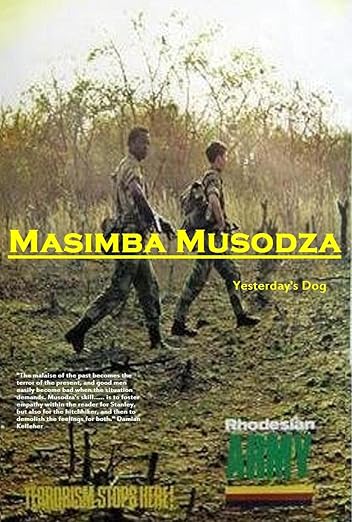
The story begins with our protagonist picking up an antiquated hitchhiker, but we get the distinct feeling his charity is not driven by empathy or anything of the sort: he is curious about something. The promise has been set, and for the next few thousand words, Musodza unravels a yarn of colonial atrocities; falsehoods, torture, extortion, and outright racism.
“And so, like one of Dr Moreau’s grotesque creations, Stanley was taken to the House of Pain. There, he felt the hand of he whose it was that wounded, and was chastised. They broke three of his teeth, three of his ribs, a leg, and several fingers. They fried his genitals with electricity, and tested the water retention of his lungs by pouring the liquid down his throat with a teapot.”
In a word, he has endured pain in its rawest sense, and the scars are still fresh in his memory. This occurred in Rhodesian Zimbabwe shortly before independence. It is also something African Baby Boomers and their children are acutely familiar with regardless of the country of origin. Like the sweet, musky, earthy smell of an old cardboard suitcase preserved in a forgotten corner: a uniquely African variety of nostalgia.
The curious thing, however, is that our protagonist’s suffering was at the hands of the very man presently sitting in his car; the antiquated hitchhiker. It is now post-independence and the tables have turned, the places switched, in a manner of speaking. For the next few kilometres, as they approach the city centre, our protagonist quietly contemplates all the nasty ways he could met out revenge against the unsuspecting passenger. The hitchhiker doesn’t know any of this, but we do. We read and hear all the horrifying things raging through Stanley’s mind:
“Between the main road and the hotel lay a long stretch of bush. Anything could happen therein, and no one who wasn’t there need know about it. The bastard could squeal like a pig, and there’d be no one to hear him. Stanley could mash that gaunt, melancholic face to a pulp. Cut off those thin lips, transform that long face into a grinning death’s head.”
It appears dissonant, for someone who has gone through such injustice to think of doing these things to another person, even if the person did those things first. In fact, many of the reviews online are unsympathetic to our protagonist because despite sparing the old dog’s life, we go on to discover that he is the new ‘dog’, an agent of the Central Intelligence Organization:
“A couple more drinks later and they were on the road again. Stanley dropped him off in the city centre. He proceeded to Chitungwiza, to a place next to the Central Police Station. A place surrounded by a concrete wall. As sis most of the establishments in the area, except that this one did not have a placard or sign to tell people what it was for. It did not need one. The only people who ever went there knew exactly the nature of the business they transacted at this complex. Those that were taken there soon found out.”
But I think that judgment among readers, like the traumatic memories of colonial torture, comes from a uniquely African place, a uniquely African memory and memory of the trauma that followed independence. In Kenya, for example, we had Special Branch (which features prominently in my next novel, Strawman). In Zimbabwe, our protagonist has joined the CIO.
Look closely at his actions, however, and one must acknowledge Stanley’s capacity for empathy. He sees himself in the hitchhiker, and a very real itinerary for what his own future could look like. He is aware that for men such as they, a long life is a much worse punishment than death; it is hell on earth. To my mind, these things amount to a positive arc. Still, the organization he works for is the new tool of oppression, and the lessons learnt seem diluted by his willingness to keep the old slave mill running. A net negative arc? You decide!
Yesterday’s Dog is available on Amazon.